
The following article looks at teaching foundation phase players awareness on the field of play. U8 players learn awareness on the ball by lifting their head, U10 players learn awareness receiving a ball by checking their shoulders and U12 players learn full field awareness on and off the ball.
“Football is played with the head. The feet are just the tools.” – Andrea Pirlo
Look at the greatest players over the past few decades and they all share the ability to be aware of their surroundings, both with and without the ball.
If players make decisions without lifting their head, they run the risk of missing better choices.
If players only look at the ball, they won’t know WHEN and WHERE to pass, run, dribble or shoot.
Teaching awareness should take place from the youngest ages.
It is important that we as coaches understand where players are in their technical, tactical, physical and social development to maximise their understanding and improvements in that area.
Awareness at U8
Technical
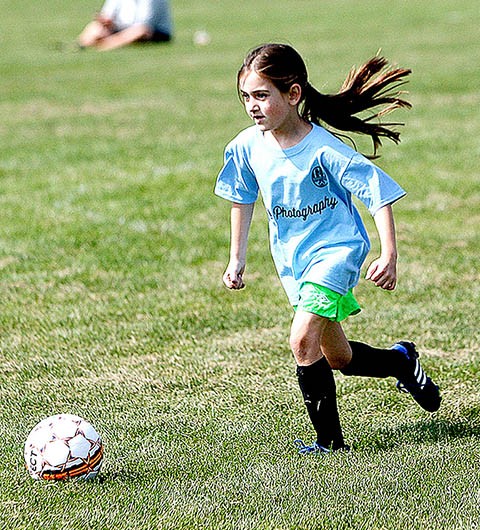
U8 players are at a prime age for developing their ball control and manipulation skills. 1 v 1 practices support this and encourage them to play with their head up.
As U8 players are comfortable understanding the benefits of passing, activities that encourage ball striking, passing & receiving and basic combination play will help aid their awareness of 2 v 1 and 2 v 2 situations in games.
Tactical
U8 players are at a prime age for developing their ball control and manipulation skills. 1 v 1 practices support this and encourage them to play with their head up.
As U8 players are comfortable understanding the benefits of passing, activities that encourage ball striking, passing & receiving and basic combination play will help aid their awareness of 2 v 1 and 2 v 2 situations in games.
Physical
Players are learning how to regulate their speed, both with and without the ball. The key fitness developments at this age are their agility, balance and coordination (ABC’s).
Games that encourage plenty of changes of speed and direction will help develop these traits.
Psycho-Social
My friend and I.
U8’s often have 1 best friend in their social situations, so small group activities suit were their social awareness is.
They are more likely to pass if they feel they will get the ball back. They are also more likely to look away from the ball as they feel confident their friend will still have it when they look back.
Practice – Through the Gates
Awareness Coaching Points
Look forward to see where you are dribbling
Look side to side to avoid other players
Look 2 gates ahead to know where you are going next
Observe to position of the defender to know the best way to turn
Why It Works
Players get to take lots of touches on the ball.
Constant changes of speed and direction allow them to use all different parts of their feet to control the ball.
Players will need to observe the positions of the defender to protect the ball as needed and keep it on the safe side as much as possible.
Additional Progressions can include team vs team – one team starts with a ball each and has a pre-determined amount of time to protect them all. If an opponent takes their ball and scores, that ball is now out of the game and they must support their team mates to offer a chance to keep the ball by passing.
Awareness at U10

Technical
Players at this age are starting to understand the details behind a good first touch – body shape, use of the back foot and playing with your head up.
Additionally they are striking the ball cleaner, with the inside of the foot in particular. Activities that involve passing and receiving are encouraged.
Tactical
Players can start to choose the best option from multiple choices. Use practices that allow for decisions such as
Which direction to move the ball
Whether to attack or keep the possession
When to press, when to delay
Physical
Players are still developing their ABC’s. They have greater regulation of their speed and are starting to learn how to use their energy at the right time.
Psycho-Social
Children are starting to form friendship groups of 3 or 4, encouraging activities such as 3 v 1 up to 4 v 4 and 5 v 5.
Players are happier to share the ball with others, understanding that they might not get it back at that moment, but will eventually.
Groups should be balanced accordingly. Competitiveness starts to increase at this age and it can lead to lesser-developed players not being trusted with the ball by others.
Play with an open body shape – how much of the pitch can you see?
Look to receive on the back foot if possible to maintain an open body
Check shoulders prior to receiving
Look up before receiving to determine how you take your 1st touch
Players will constantly be receiving the ball to feet. This encourages them to lift their head and check their shoulders so that they determine the ideal first touch to take.
Working as a small group is necessary to achieve success, with players having to observe defenders position to create the correct supporting angles.
The practice allows players to see the benefits of an open body shape.
Awareness at U12

Technical
U12’s should start looking at their weight of pass, especially when playing the ball into space. Accuracy should also be considered.
Pay attention to the body shape of players – how much of the pitch does this allow them to see and how they are able to control the ball if it passed to them.
Tactical
Clever, timed movement, with a big focus on forward runs off the ball. Players need to start considering the offside line when making a run forward.
Players should be encouraged to look away from the ball to see available spaces to move into. Awareness of the potential to move an opponent out of a space to allow a team mate to move into can be addressed.
Physical
Upper body control. In early years, use of the head and chest can be intimidating. With growth spurts occurring at U12 and more balls being played aerially, players need to become comfortable with this.
Growth spurts and height differences can allow taller players to see over opponents heads and options further up the pitch.
Social
Players are to consider non-verbal communication to unbalance opponents. This can be in the hand-signals, eye contact and movements of intention. Understanding team mates preferred movements, touches and decisions should also be considered.
Practice – Killer Pass Game
Awareness Coaching Points
Observe the player on the ball to make sure they are facing forward to make the killer pass
Observe the defenders position to see if there is a gap that allows the killer pass to be made
Look across the line of cones so that you can time your run
Look at the goal while running into the endzone to make your decision on where to place the ball
Eye contact between player on ball and runner
Why It Works
The killer pass requires the correct weight and accuracy for the players to have success, especially when defenders are allowed to recover.
Timing of the run and the through-ball is vital. Eye contact between players makes sure this happens.
A lofted killer pass encourages players to head at goal or take the ball on their chest.